India as a textile partner

A complete value chain —
yarn to final garment.

India is one of the world's most diverse and integrated textile ecosystems — offering unmatched depth across raw materials, manufacturing capabilities, craftsmanship, and scale. It is one of the few countries in the world with a complete textile value chain, allowing buyers to develop, scale, and diversify sourcing from a single geography.

Cream and beige linen folds in warm light
India by the numbers

Scale & depth at a glance.

India is the world's second-largest textile producer and one of the top five exporters. It contributes ~2.3% to GDP and ~11% to manufacturing GVA, and is the country's second-largest employer after agriculture.

2nd Largest textile producer globally
45M+ People employed in the sector
$36B Textile & apparel exports (FY24)
4.6% Share of global textile trade
$174B Domestic market (2024)
$350B Projected market by 2030

Sources: Ministry of Textiles, IBEF (2025-26)

Why India continues to be a preferred sourcing destination

Five reasons global buyers keep coming back.

  1. 01 Among the largest producers of cotton and natural fibres globally India grows a significant share of the world's cotton, jute, silk, and wool — with a rising base of organic and BCI-certified cotton for buyers who need traceable, responsibly-grown fibre.
  2. 02 A wide base of spinning, weaving, knitting, dyeing, and processing units From integrated mills to specialised finishers, India offers depth at every stage of the textile value chain — often within a single cluster or state.
  3. 03 Strong capabilities across both mass-scale production and specialised developments Whether the requirement is a container of standard poplin or a bespoke jacquard, India has mills sized right for both.
  4. 04 Cost-efficient manufacturing supported by skilled workmanship Generations of textile expertise mean that quality workmanship is available at price points that continue to compete globally.
  5. 05 Growing focus on compliance, traceability, and responsible production Certifications like GOTS, OEKO-TEX, BCI, and Higg-audited facilities are now standard among leading suppliers — increasingly matched by transparency across the supply chain.
For global brands

Greater flexibility, consistent quality,
long-term stability.

The combined effect of India's complete value chain, deep specialisation, and rising compliance standards means that global brands sourcing from India get more than just fabric — they get a system that supports growth.

Flexibility

Develop, scale, and diversify from one geography. Move between fabric families and price points without changing sourcing country.

Consistency

Established supply chains and long-standing mill relationships mean quality holds — season after season, order after order.

Stability

A domestic base of raw material, spinning, and finishing means less exposure to single-point supply shocks.
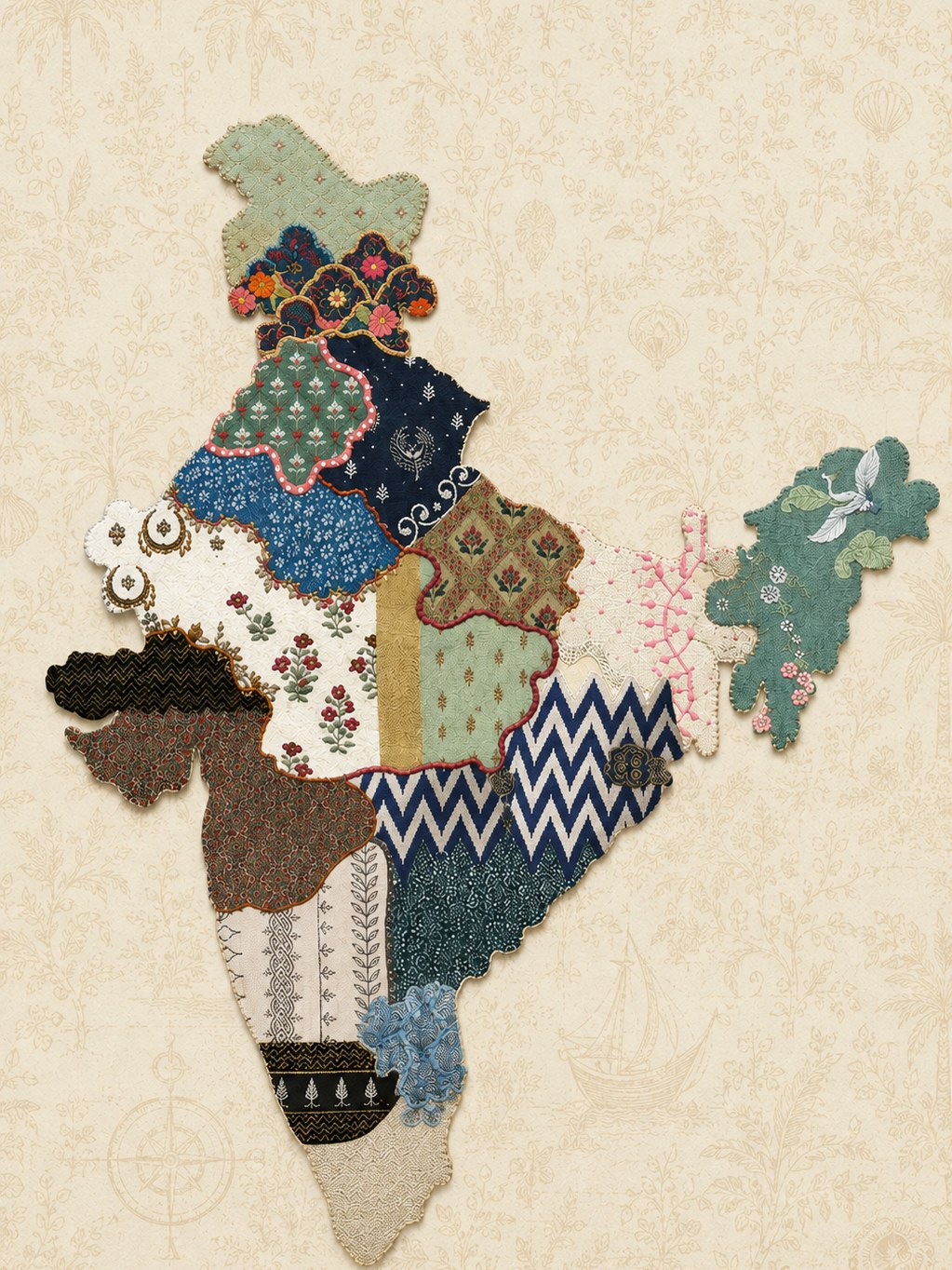
Map of India as a patchwork quilt, each state stitched from a different regional textile — an illustration of India's fabric diversity
A geography of textiles

Every state, a specialty.

India's textile industry isn't concentrated in one place — it's spread across dozens of clusters, each with its own specialty built over generations.

Maharashtra — Cotton weaving, powerlooms (Ichalkaranji, Bhiwandi)
Gujarat — Denim, textile processing, prints
Tamil Nadu — Knits, garmenting (Tirupur, Coimbatore)
Karnataka — Silk, ready-made garments (Bangalore)
Rajasthan — Hand block prints, natural dyes (Jaipur, Sanganer)
Punjab & Haryana — Cotton yarn, home textiles (Panipat, Ludhiana)
What's next

7 mega parks. The next India.

Under the PM MITRA scheme, India is building 7 mega integrated textile parks — each combining spinning, weaving, dyeing, processing, and garmenting under one roof. Rs 70,000 crore of investment expected, with ~20 lakh new jobs. These parks — alongside a global shift toward supply chain diversification and expanding technical-textile capacity — are reshaping India's next decade of manufacturing.

01 Tamil Nadu Virudhunagar
02 Telangana Warangal
03 Gujarat Navsari
04 Karnataka Kalaburagi
05 Madhya Pradesh Dhar
06 Uttar Pradesh Lucknow
07 Maharashtra Amravati
Technical textiles $45B market, targeting $65B+ by 2030
Supply chain diversification Global brands increasing India allocations
2030 target $100B textile export goal
Where MLB fits in

The country is vast.
We know it intimately.

Four decades of relationships across every major textile cluster in India — and a working knowledge of which mill fits which brief. We help buyers navigate this vast market with confidence, aligning fabric development with design intent, and ensuring reliable execution from sampling to delivery.